

20-Inch Cutter Suction Dredger from China: Top Supplier Insights
2026-06-15
When it comes to powerful and efficient dredging solutions, the 20-inch cutter suction dredger stands out as a workhorse in the industry. As a leading YaKai Dredger specialist, we've seen firsthand how these machines transform challenging waterways into navigable routes and profitable operations. But what makes a top supplier in China truly exceptional? In this post, we dive into the key insights you need before making an investment, from advanced engineering to after-sales support that keeps projects on track.
The Real Workhorse of Modern Dredging
When people picture dredging, they often imagine massive hopper dredgers sailing across open waters. But the true backbone of most projects sits quietly, churning day and night without much fanfare: the hydraulic cutter suction dredger. This machine combines brute force with precision, able to chew through rock, clay, sand, or silt and pump it miles away. Its stationary nature belies its versatility—it can work in confined harbors, deep channels, or even land reclamation sites where mobility isn't the priority, but sheer throughput is.
What sets it apart is the marriage of the cutter head and the robust pump system. The rotating cutter arm digs into the seabed, breaking up material, which is immediately sucked into the discharge pipeline. Modern designs have pushed efficiency further with submerged pumps and automated swing controls, allowing operators to maintain a consistent slurry density. This means less water is moved, and more solids end up where they need to be—vital for keeping costs down on capital-intensive projects.
Yet the workhorse label isn't just about power; it's about adaptability. These dredgers can be customized with tooth cutters for soft rock, wheel cutters for hard ground, or plain suction heads for loose soils. They're often assembled on-site from transportable components, making them viable for remote operations. From deepening the Panama Canal to building artificial islands, the cutter suction dredger remains the quiet giant that gets the job done—unseen by most, but indispensable to global infrastructure.
What Sets a 20-Inch Cutter Suction Dredger Apart
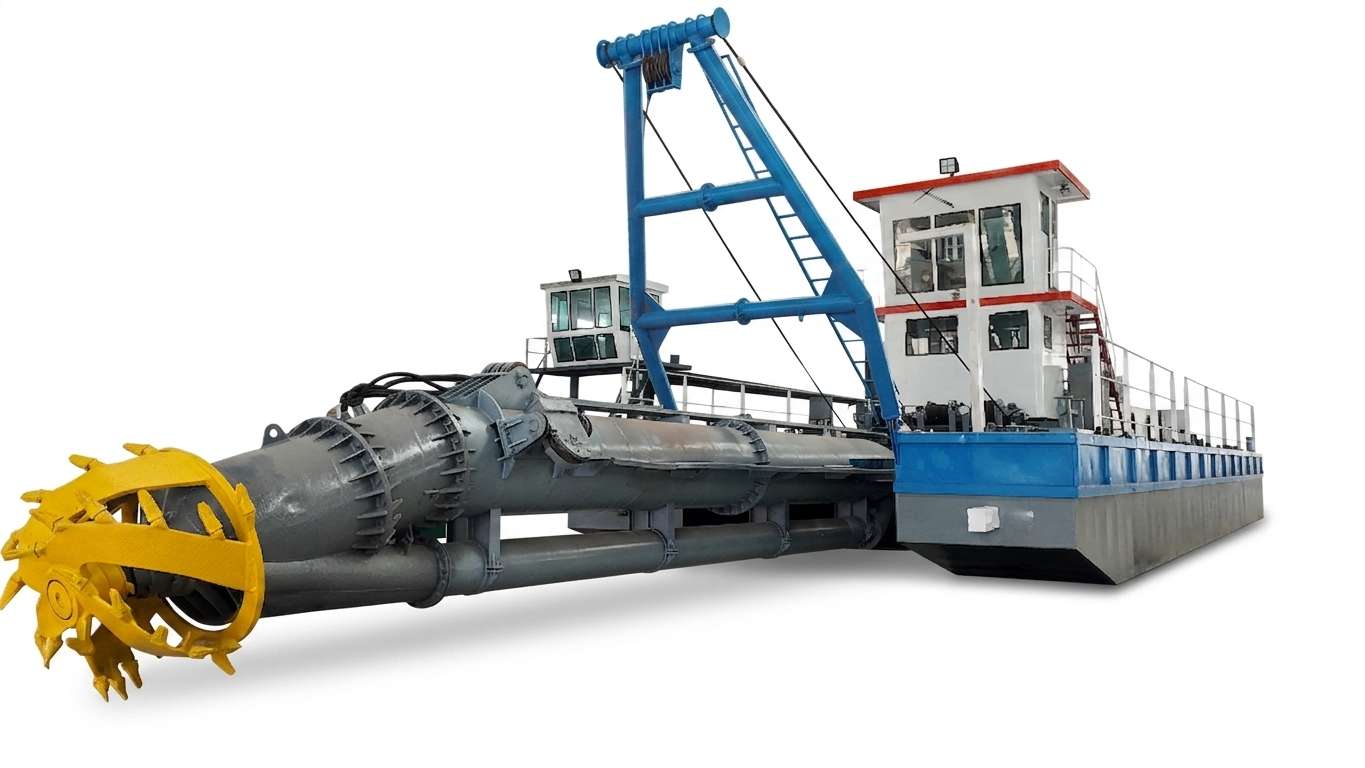
The 20-inch cutter suction dredger carves a niche defined by its balance of mobility and muscle. Unlike smaller units that struggle with harder materials, this size wields enough cutter power and pump capacity to handle compacted sands, stiff clays, and even soft rock without constant repositioning. It slots into projects where a 16-inch dredger would crawl and a 24-inch would be overkill, making it a favourite for medium-scale port maintenance, land reclamation, and pipeline trenching near fragile shorelines.
What surprises many is how the hull design adapts to demanding environments. A 20-inch model often features a demountable structure, allowing it to be shipped in containers or overland to landlocked sites. Some variants incorporate a spud carriage system that extends the working reach without dragging anchors, speeding up cycle times in confined basins. The discharge distance can exceed 2 kilometres when boosted, yet the overall draft remains shallow enough to work in tidal zones where deeper-draught vessels cannot tread.
Operators value the straightforward mechanical layout that trims daily maintenance. Critical components like the cutterhead gearbox and ladder pump sit close to the water surface, reducing suction losses and easing inspections. Unlike larger dredgers that demand specialist crews, a 20-inch platform can be run by a compact team, keeping manning costs low. Its noise footprint also stays within tighter limits, a detail often overlooked until urban or eco-sensitive contracts demand compliance. This blend of pragmatism and power is what keeps the 20-inch dredger on tender lists year after year.
Behind the Scenes with China’s Top Dredger Builders
In the sprawling shipyards that line China’s coast, a quiet revolution takes shape – one massive steel hull at a time. The engineers and welders who build the nation’s fleet of cutter-suction and trailing-suction hopper dredgers rarely make headlines, yet their work reshapes continents. We spent weeks inside the workshops, watching precision cutting machines carve out pump housings the size of small houses and listening to the hum of generators that power vessels capable of moving millions of cubic meters of sediment. The atmosphere is a blend of heavy industry and meticulous craftsmanship, where a single misaligned weld could mean the difference between a project’s success and a costly failure.
Beyond the technical prowess lies a human story of relentless problem-solving. Veteran fitters recounted nights spent troubleshooting the complex cutter-head drives, adapting designs on the fly when imported components failed to meet the required torque. One lead designer showed us scribbled notebooks from the early 2000s, when the team reverse-engineered foreign dredgers just to understand how they achieved such suction efficiency. Today, those same engineers mentor a younger generation, passing down tricks for balancing vibration in the ladder arms and achieving the perfect blade angle. It’s this layered knowledge, built through trial and error, that now allows the shipyards to turn out a dredger every few months without losing any of the fine-tuning that makes them work in the world’s toughest harbors.
The testing phase reveals the true character of these floating giants. We stood on the bridge of a newly launched dredger during sea trials, feeling the deck tremble as the cutter head bit into a simulated rock formation. The crew, a mix of seasoned captains and fresh maritime graduates, communicated in clipped phrases, their focus absolute. After each run, data streamed onto screens: cutting force, pump flow rate, mixture concentration. Adjustments were made not with fanfare but with quiet nods and a few keystrokes. By the time the vessel returns to port for its final coat of paint, it has already proven itself a precision instrument, ready to carve deeper shipping lanes or reclaim land from the sea with an efficiency that still surprises even the people who built it.
From Riverbeds to Coastal Projects: Where These Dredgers Shine
There’s something almost surgical about the way a modern dredger carves through compacted silt and clay along a winding riverbed. Without ever leaving the water, these machines restore depth where centuries of sediment have slowly choked the flow, keeping trade routes open for barges that haul goods far cheaper than any highway ever could. The real artistry shows up in tight bends and shallow draft zones, where a few extra inches mean the difference between a stranded vessel and a smooth transit.
Move out to the coast and the game changes entirely. Those same pumps and cutterheads that refreshed an inland channel now anchor massive beach replenishment jobs, pulling sand from miles offshore and laying it down in precise contours. Harbour expansions and land reclamation take it a step further, demanding not just brute force but a careful dance around tides, currents, and sensitive marine habitats. That’s where the best equipment earns its keep—not through raw power alone, but through an almost intuitive adaptation to the water’s own rhythms.
Making Sense of the Long-Term Value Proposition
Understanding long-term value isn't about predicting the next quarter's earnings—it's about grasping the fundamental drivers that sustain a business over decades. Too often, companies get caught up in short-term metrics, sacrificing the durable advantages that compound with time. Real value stems from a cohesive strategy that aligns product innovation, customer trust, and operational resilience. When these elements work in concert, they create a moat that competitors struggle to replicate, even as markets evolve.
Investors and executives alike misread value when they focus solely on financial statements without considering the qualitative forces at play. A brand's reputation, its culture of adaptability, and its ability to attract top talent aren't line items on a balance sheet, yet they often determine whether a company thrives or merely survives. Consider how some firms weather disruptions precisely because they've nurtured these intangibles over many years—they're not luckier, they're simply playing a longer game.
The challenge is that the long-term value proposition asks for patience in a world obsessed with instant results. It requires a mindset shift: from maximizing immediate returns to optimizing for sustainable growth. This doesn't mean ignoring profitability; rather, it means redefining it through the lens of endurance. The companies that endure are those that embed their purpose into everyday decisions, making value creation a habit, not a one-time initiative.
Insider Tips for a Smooth Procurement Journey
Kick things off by mapping your actual needs before diving into supplier lists. It's tempting to jump straight to quotes, but a rushed scope leads to mismatched solutions. Talk to the people who'll use the product daily — their wish list can reveal non-obvious requirements that prevent expensive workarounds later. One procurement manager I know shaved weeks off a software rollout simply by having IT shadow the end users for two days.
When you do reach out to vendors, don't just fire off a generic RFQ. Take fifteen minutes to tailor the request — mention specific pain points from your earlier discovery. This transparency nudges suppliers to propose realistic timelines and sometimes unadvertised options. I've seen a manufacturer swap out a custom component for an off-the-shelf alternative, cutting delivery time by 40%, simply because the buyer described the problem instead of just the specs.
Finally, keep a shared log of every decision, promise, and hiccup. It's not bureaucracy; it's a memory. When a vendor's rep moves on or a stakeholder forgets why a certain route was chosen, that single source of truth stops rework cold. A client once avoided a six-figure penalty because their notes showed the supplier had confirmed a delivery window that their own CRM had overwritten.
FAQ
Its balance of portability and output is hard to beat. A 20-inch dredge can handle a solid range of materials—from silt to moderately compacted sand—while still being transportable by road or sea without massive logistical headaches. For many contractors, it hits the sweet spot between power and operational flexibility.
They typically focus on three things: heavy-duty wear plate materials for the pump and cutterhead, certified marine-grade steel for the hull, and rigorous factory testing before shipping. Many also offer on-site assembly supervision and commissioning support to make sure the dredger performs as promised from day one.
You’ll definitely want to look at the maximum dredging depth, the pump’s flow rate and head, engine power (often a Cummins or CAT marine diesel), and the type of cutter drive—mechanical or hydraulic. Also, pay attention to the spud system and whether the dredger can be disassembled for container transport if you’re moving it between sites.
It depends on the cutter setup. Standard models are designed for sand, clay, and soft rock, but many suppliers can upgrade the cutterhead with heavy-duty teeth and more powerful hydraulic motors for fractured rock or hardpan. However, for continuous hard rock dredging, a larger cutter suction dredger or a specially engineered rock cutter might be more suitable.
Cost is a big factor, but it’s not the only one. Chinese builders have become much faster at customization and delivery—often turning around a fully built dredger in a few months. Plus, spare parts are easier and cheaper to source, and many suppliers now offer comprehensive after-sales service packages that rival Western standards.
Daily checks should focus on cutter tooth wear, suction pipe clogs, and hydraulic oil levels. Weekly, inspect the pump impeller and wear plates. After every major project, it’s wise to do a full hull inspection and repaint areas prone to corrosion. A lot of operators also keep a logbook to track engine hours and component replacements—it helps with preventive scheduling.
As the discharge line gets longer, friction losses increase and output drops. To reach longer distances—say over 1,500 meters—you’ll likely need a booster pump station. Some Chinese models come with a built-in high-efficiency pump that already gives you a decent 1,000-meter range, but for anything beyond that, plan the pipeline layout carefully and consider a booster.
First, get an experienced freight forwarder who knows heavy machinery—disassembly and loading can be complex. Second, even if the dredger comes with CE or other certifications, check local regulations for marine emissions and safety standards. Third, factor in a training program for your crew; many suppliers offer on-site training for a week or two, and that makes a huge difference in getting up to speed quickly.
Conclusion
A 20-inch cutter suction dredger isn't just another piece of equipment—it's the backbone of countless waterway and land reclamation jobs. What makes this size so practical is the balance it strikes between raw digging power and operational efficiency. With a cutter that can chew through compacted sand, clay, and even soft rock, it handles the tough stuff without the fuel burn of larger vessels. Chinese shipyards have quietly perfected these machines, combining heavy-duty build quality with smart modular designs that simplify transport and assembly. Behind the polished product lies a network of specialized engineers who obsess over pump curves and wear-resistant metallurgy, ensuring that every dredger leaves the yard capable of non-stop performance.
These dredgers thrive in environments where precision matters—think river deepening, port maintenance, or coastal restoration. Their real genius lies in the long-term numbers: lower spares consumption, straightforward maintenance, and a resale value that holds up surprisingly well. When you're sourcing one, skip the glossy brochures and dig into the technical specs yourself. Visit the factory if you can, watch a sea trial, and talk directly to the people who designed the dredge pump. The best insights rarely come from a website—they come from understanding how these machines are built and who stands behind them when something inevitably wears down.
Contact Us
Contact Person: Nancy
Email: [email protected]
Tel/WhatsApp: (+86) 13869631558
Website: https://www.yakaidredger.com/