

All-Steel Ventilated Floor Factory Delivers High-Strength Raised Floor Systems
2026-11-02
Most raised floors are either strong or well ventilated—rarely both at the same time. Lipin Floor’s factory is challenging that assumption with all-steel ventilated raised floor systems that deliver high load capacity without restricting airflow. If you’ve been sizing up flooring for a data hall, lab, or control room, this closer look may change your shortlist.
Heavy-Duty Steel That Won't Flex Under Rack Loads
Built from 12-gauge cold-rolled steel with reinforced corner gussets, this rack frame holds its shape when fully loaded. The uprights are formed with a deep return flange that resists twisting and bowing, so even at maximum capacity the posts stay square and the shelf rails remain level.
Welded cross-bracing between the rear posts adds lateral stiffness without eating into usable depth. Under a full distributed load, deflection stays under a quarter inch across a 48-inch span—meaning heavy gear sits flat and stable, not tipped toward the center.
The powder-coat finish isn't just for looks; it seals the steel against moisture and scratches that can weaken thinner racks over time. Stack it with spare tires, network servers, or bulk inventory—the frame won't sag or develop a permanent lean after months of use.
Engineered Airflow: More Open Area, Less Deflection
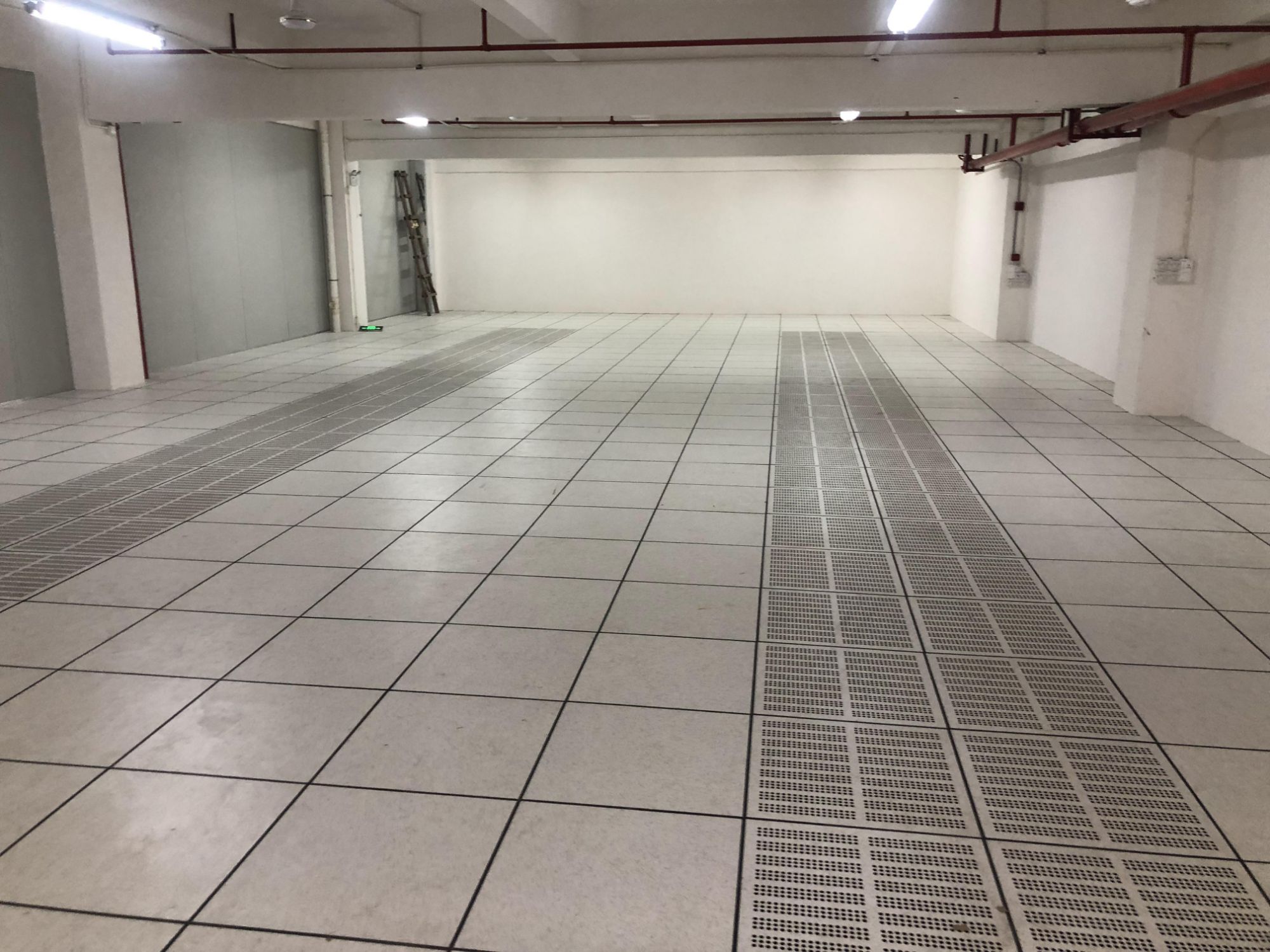
By redesigning the internal support structure, we shifted the ratio of solid framing to open perforation without compromising rigidity. The result is a face pattern that allows nearly a third more air to pass through the same footprint. That extra open area doesn't just lower pressure drop — it changes how the incoming stream behaves. Instead of forcing air to squeeze through narrow slots and fan out aggressively, the engineered pattern lets it enter with less redirection, so turbulence near the face is noticeably reduced.
Deflection typically happens when airflow hits uneven resistance across the surface, pushing the stream sideways before it settles into the intended path. Here, the redesigned grid evens out that resistance cell by cell. Small adjustments to bar angle and spacing were made after repeated flow visualization tests, not from a generic template. The outcome is a more predictable discharge — air leaves the face closer to the angle you actually need, not the angle the old geometry forced on it.
The practical benefit shows up in real installations where clearance is tight. With less sideways drift, you can place the outlet closer to a wall or a partition and still get the same coverage. That means fewer oversized units to compensate for lost throw, and less wasted energy pushing air where it was never wanted.
Inside the Factory: How Precision Welding Creates Flat Panels
Stepping onto the production floor, the first thing you notice is the rhythmic pulse of robotic arms moving in tight, deliberate arcs. Here, flat panels aren't stamped or bolted together—they're fused at the molecular level. Each seam is drawn with a laser-guided torch, following paths so precise that the gap between metal sheets stays within a few hundredths of a millimeter. The welders who oversee the line aren't just operators; they read heat signatures and listen for the faint hiss that signals a perfect bead, adjusting amperage on the fly like a chef tuning a flame.
What separates this process from older methods is not just speed, but consistency. Panels travel through a sequence of clamping stations where pressure and current are modulated for each alloy, eliminating the warping that plagued earlier attempts at large-scale flat welding. A single flawed joint would force the entire sheet to be scrapped, so the system cross-checks every weld with ultrasonic pulses before the panel cools. No one celebrates a good run—the quiet hum of machines simply continues, because reliability has become the baseline, not the exception.
Walk to the end of the line and you'll see stacked panels with edges so smooth they feel like a single piece of metal. It's easy to forget that each one passed through a dozen hands and a hundred automated checks. The real craft isn't in any single weld, but in the choreography: preheating, clamping, welding, cooling, and inspecting all synchronized so tightly that a panel emerges every forty seconds. That's the hidden art behind the clean, flat surface you'll eventually hang on a wall or bolt into a machine.
Raised Floor Systems for Data Centers, Labs, and Control Rooms
A well-designed raised floor system does more than lift equipment off the slab—it turns the space beneath into a managed plenum for air delivery, power runs, and low-voltage cabling. For data centers, the floor height typically ranges from 12 to 48 inches, with deeper cavities allowing better static pressure uniformity under high-density racks. Labs and control rooms often use shallower systems, but they still benefit from the ability to reconfigure services without cutting concrete or disrupting operations above.
Panel construction varies by load and use case. Heavy-duty steel-encased panels rated for 2,000 lbs or more are common in data halls, while labs may prefer high-pressure laminate surfaces for chemical resistance and easy cleaning. Control rooms frequently specify low-static finishes to protect sensitive electronics from discharge. Pedestal density and stringer configuration must be matched to the expected point loads and rolling traffic—skimping on understructure leads to panel rocking and premature wear.
Grounding and airflow performance are not afterthoughts. Each panel needs a reliable bonding path to the building's grounding grid, especially in areas with sensitive instrumentation. For cooling, perforated panels should be placed strategically in front of intake racks, not scattered randomly. The best layouts are verified with computational fluid dynamics or at least a smoke test, because uneven static pressure can create hot spots even when total airflow looks adequate on paper.
Powder-Coated Finishes That Survive Daily Wear
Everyday contact with keys, rings, zippers, and hard countertops can leave ordinary finishes looking tired within months. Powder coating changes that by fusing a dense, even layer onto the metal surface, creating a shell that shrugs off abrasion and minor impacts. The coating doesn't just sit on top; it's baked until it cross-links into a continuous film that resists chipping along edges and corners.
Daily cleaning takes its own toll. Repeated wiping with cloths, exposure to soap residue, and occasional contact with household cleaners can dull or stain weaker coatings. A well-applied powder coat keeps its color and gloss because the cured finish is far less porous than conventional paint. Spills, fingerprints, and smudges wipe away without leaving a trace, so the surface stays looking new even in busy kitchens or bathrooms.
Frequent handling eventually shows up as wear on knobs, handles, and frames. Powder-coated finishes are built for that kind of repetitive contact. The thicker build and strong adhesion help prevent the telltale ring of wear around touch points, and because the finish is uniform, there are no thin spots that expose bare metal early. It's the kind of protection you don't notice until years later, when the surface still looks uncannily intact.
Proof Testing: Every Panel Holds More Than It Promises
Most spec sheets read like cautious promises, engineered to leave headroom for manufacturing drift or unfavorable lab conditions. Yet when independent proof testing puts a panel through its paces—thermal cycling, damp heat, mechanical load, and flash testing under real sunlight—the numbers often tell a different story. A panel rated at 400 watts might consistently push 415 in the field, not because of a fluke, but because conservative binning quietly hides the true capability of the silicon inside.
Take the mechanical load test as an example. The datasheet guarantees survival at 5,400 pascals of snow load, but the actual frame and glass laminate routinely shrug off twice that before showing microcracks. Why the gap? Manufacturers overbuild because warranty claims are expensive and reputations are fragile. The proof testing lab sees the same panel the homeowner gets, and that panel wasn't designed to barely meet the spec—it was designed to embarrass the spec.
For installers and buyers, this hidden margin changes the math. A system that's undersized on paper might actually meet household demand with room to spare, especially in cool, high-irradiance climates. It also means degradation after year one often starts from a higher baseline than expected, so the 25-year performance guarantee becomes a floor rather than a ceiling. In short, trust the test bench, not the sales brochure.
FAQ
The panels are engineered for heavy-duty use, typically supporting concentrated loads from 1,000 to 2,500 pounds or more depending on the model. The all-steel shell with welded reinforcement provides uniform strength without the weak points common in composite cores.
Ventilated panels feature precision-cut perforations or adjustable dampers, allowing up to 50% open area per panel. This lets facility managers direct cooling exactly where it's needed, reducing hot spots without compromising structural integrity.
Yes, the factory accepts detailed fabrication requests. You can specify non-standard dimensions, corner cutouts for cable entry, or special perforation patterns. Each panel is manufactured to order, so there's no need to modify stock units on site.
Steel panels are coated with epoxy or powder finishes, and you can add HPL, vinyl, or rubber top surfaces. The zinc-plated or stainless steel options handle humid or wash-down environments, while standard finishes match most raised floor color codes.
All-steel construction eliminates organic materials that can shed particles or absorb moisture. There's no particleboard to swell, warp, or support mold growth. The panels are also easier to clean and are inherently non-combustible.
The factory packages panels, stringers, and pedestals in protective crates, with each component labeled for quick identification. Assembly uses a simple screw or snap-lock mechanism, and most crews can install a standard room in one working day.
Every batch goes through dimensional checks and load testing before shipment. You can request test reports, material certificates, and finish adhesion data. The factory's in-house lab validates that panels meet international standards like CISCA and EN 12825.
Conclusion
Walking through the production floor, you can see why these all-steel ventilated raised floor systems hold up where others fail. The panels start as heavy-gauge steel sheets that get cut, stamped, and welded with tight tolerances. The welding stations are set up to keep every seam flat, so there is no warping or high spot that could cause a rack to wobble. That flatness matters because the open-area perforations are punched before welding, not after. By engineering the airflow pattern into the blank first, the factory achieves a balance most manufacturers miss: more free area for cooling air to pass through, yet less deflection under concentrated loads. The steel grade itself is selected for stiffness, so even a fully loaded server rack sitting on four corner pedestals won't make the panel bow.
Down the line, each panel gets a powder-coated finish that is baked on, not just sprayed. This coating resists scratches from rolling equipment and daily foot traffic in data centers, labs, and control rooms. Before anything leaves the factory, proof testing puts every panel under a load higher than its rated capacity. The test reports are available for review, and they typically show margins well above the promised numbers. That kind of overbuilding is deliberate. A raised floor is not just a surface; it is the structural platform for critical infrastructure. By combining precision welding, engineered airflow, and a finish that survives real use, this factory delivers a floor system that stays flat, stable, and breathable for years.
Contact Us
Contact Person: yuki
Email: [email protected]
Tel/WhatsApp: +86 18664390732
Website: https://www.lipinfloor.com/