

Best Aixtron G5+ GaN Epitaxy Susceptor for High-Quality GaN Layer Deposition
2026-11-16
If you've ever watched an Aixtron G5+ run end in uneven GaN thickness or stubborn particles, you already know the susceptor is rarely innocent. It sits at the heart of every high-quality GaN layer deposition, quietly dictating thermal uniformity, gas flow, and wafer cleanliness. Yet many fabs still treat it as a commodity—until yield tanks. At Semicorex, we took a different route: engineering a G5+ susceptor to eliminate the failure modes that generic graphite and SiC coatings can't. Here's what we found—and why it matters for your next epitaxy campaign.
The Susceptor's Hidden Role in GaN Defect Density
The susceptor's influence extends far beyond simple wafer support. During GaN epitaxy, modest differences in susceptor thermal mass, emissivity, and surface finish create localized variations in wafer temperature that are rarely captured by pyrometer readings. These thermal non-uniformities alter adatom surface mobility, causing uneven incorporation of gallium and nitrogen and leading to the formation of basal-plane stacking faults and threading dislocations clustered near wafer edges.
Material choice adds another layer. A graphite susceptor coated with SiC can participate in unintended gas-phase reactions with NH3 or H2, releasing trace carbon or silicon into the growth environment. The resulting background doping shifts the Fermi level and changes the formation energy of native point defects, effectively raising or lowering the density of VGa-related complexes even when growth parameters remain unchanged. Operators often overlook this because the effect is slow and cumulative.
Perhaps more hidden is the mechanical interaction. Repeated thermal cycling causes micro-deformation of the susceptor pocket, so wafers may sit slightly tilted or with uneven backside contact. This changes the local heat transfer path, producing a defect signature that appears random across a batch but is actually repeatable for a given susceptor history. Identifying it requires correlating defect maps with pocket-level temperature history, not just reactor-level averages.
Thermal Gradients You Can Actually Control on the G5+
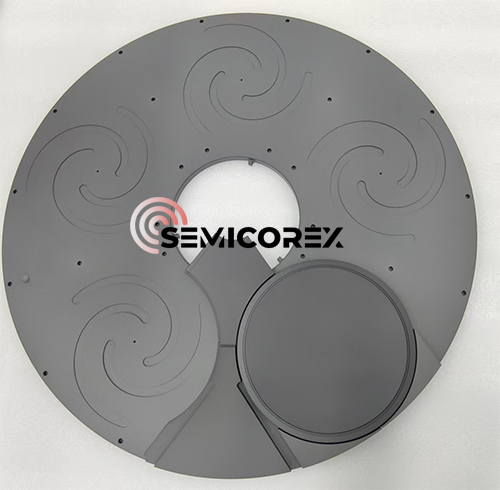
Most machines treat heat like an afterthought—one coarse setting and a lot of hoping. The G5+ gives you actual control over thermal gradients, and it shows up in the results. You can set separate temperature bands across the work area and adjust them without stopping the job.
The difference isn't subtle when you're working with materials that curl, shrink, or cure unevenly. Being able to nudge a mid-zone down by a couple degrees while keeping the edges warmer changes how predictable the whole process feels. It stops being a guessing game.
After a few runs you learn the offsets that work for your space and materials. The G5+ remembers those settings, so the gradient stays stable instead of drifting as the room warms up or the workload changes.
Why Pocket Depth Dictates Gas-Phase Chemistry
The depth of a molecular pocket does more than provide a physical cavity; it reshapes how gas-phase reactants encounter active sites. Shallow pockets allow molecules to drift in and out with minimal residence time, often leading to low conversion because the reactant barely samples the catalytic interior. Deeper pockets, by contrast, trap gas molecules through a combination of van der Waals confinement and reduced escape probability. This extended dwell time increases the likelihood of productive collisions with reactive centers, effectively turning a passive void into a kinetic filter that favors slower, more demanding reaction pathways over rapid but non-selective encounters.
Beyond simple confinement, pocket depth alters the local electronic environment that gaseous species experience. A deep, narrow cavity can distort the electron cloud of an incoming molecule, polarizing bonds that would remain inert in open space. This electrostatic pre-activation lowers the barrier for specific bond rearrangements, meaning the same metal or acid site behaves differently depending on how far it sits from the pocket mouth. In practice, a catalytically active iron atom buried 8 angstroms deep may promote C–H activation, while an identical atom near the surface only facilitates weak physisorption—purely because the depth changes the field gradient felt by the gas molecule.
This principle shows up clearly in shape-selective zeolites and enzyme active sites, where product distribution tracks pocket geometry rather than intrinsic site reactivity. For instance, gas-phase alkane cracking over medium-pore zeolites yields more branched isomers when the pocket is just deep enough to stabilize the bulkier transition state, while shallower analogs produce linear fragments. Similarly, methane monooxygenase uses a deeply buried diiron center to convert methane to methanol at ambient conditions, a feat impossible for surface-exposed iron complexes. The depth is not incidental; it creates a microenvironment where gas-phase chemistry follows rules dictated by physical constraint as much as by electronic structure.
Coatings That Outlast Standard SiC in Production
Production teams often replace silicon carbide chamber parts not because the bulk material wears through, but because micro-cracks near bolt holes and gas ports start to shed particles. The next-generation coatings get around this by alternating dense and slightly compliant sub-layers, which stops a crack before it reaches the surface. In cyclical thermal loading, coated graphite and coated SiC substrates keep their surface roughness for roughly twice as many wafer runs as uncoated or conventionally coated SiC.
The difference is most visible in etch and deposition tools that run fluorine or chlorine chemistries. Standard SiC slowly converts to volatile halides at grain boundaries, leaving pitted areas that become particle sources. The newer coating formulations instead build a self-limiting oxide-fluoride layer that passivates the surface, so the erosion rate drops by more than half. Maintenance logs from high-volume fabs show fewer mid-campaign chamber opens and less frequent wet cleans on coated gas distribution plates.
One overlooked benefit is dimensional stability. Coatings that outlast SiC do not just stay intact; they stay flat. Warpage from uneven corrosion can shift gap spacing and alter plasma uniformity, which quietly degrades yield before the part fails. With these coatings, process engineers report tighter critical dimension control deeper into the preventive maintenance cycle, which means longer intervals between requalification runs and fewer test wafers burned on tool recovery.
Wafer Warpage and the Susceptor's Silent Countermeasures
Wafer warpage rarely announces itself with a dramatic crack or a visible bend. Instead, it creeps in as a subtle curvature, a fractional tilt that grows under thermal stress until the entire deposition process drifts out of tolerance. The susceptor, often mistaken for a passive support plate, is actually the first line of defense against this deformation. Its design quietly redistributes mechanical and thermal loads, holding the wafer flat enough to keep film thickness uniform across every die.
One of the susceptor's most effective countermeasures is its material memory. High-performance graphite coated with silicon carbide does not simply resist warpage; it absorbs the wafer's tendency to curl by matching expansion rates more closely than traditional metals. This compliance, paired with precision pocket geometry, lets the susceptor cradle the wafer without introducing new stress points. As local temperature spikes push the wafer edge upward, the susceptor's own stiffness counters that lift, not by force but by balanced thermal inertia.
What often goes unnoticed is how the susceptor's surface finish acts as a silent negotiator. A slightly roughened or micro-textured contact area increases friction just enough to prevent micro-slippage during ramp-up, while still allowing the wafer to settle into a stress-free position after cooling. This dynamic equilibrium means the wafer never fights the susceptor; instead, the two move together through each thermal cycle. Over hundreds of process runs, that silent cooperation is what keeps warpage from becoming a yield killer.
From Run to Run: How Susceptor History Shapes Layer Quality
A susceptor is never a blank slate after its first heating cycle. Repeated exposure to process gases and thermal stress gradually alters its surface: micro-cracks propagate along the coating, metallic impurities diffuse outward, and thin parasitic deposits accumulate in recessed pockets. These changes are not cosmetic. They shift the local emissivity and thermal contact resistance, so the same pyrometer reading can correspond to a different actual wafer temperature than it did fifty runs ago. As a result, growth rate, ternary composition, and dopant incorporation begin to drift even when the recipe remains untouched.
The more insidious effect is run-to-run memory. A susceptor that sat through a heavily doped or aluminum-rich deposition will retain trace amounts of those species in its pores and edge regions. During the next run, those trapped atoms outgas or surface-exchange at unpredictable moments, creating a chemical background that no mass flow controller can cancel. Layer quality then becomes a function of the susceptor's biography: which precursors it saw, how fast it was cooled, and how many times it has been baked clean. Engineers learn to read that history in wafer maps and sheet resistance tails, often discovering that the best process optimization is not a new recipe, but a disciplined susceptor conditioning schedule.
FAQ
The G5+ susceptor uses a refined pocket geometry and improved thermal mass distribution, which helps maintain a flatter temperature profile across the wafer. That translates into fewer edge defects and more consistent indium incorporation in InGaN layers, so the resulting GaN stack has better thickness and composition uniformity.
Most G5+ susceptors are made from graphite coated with silicon carbide. The graphite core responds quickly to RF or resistive heating, while the SiC coating protects the surface from ammonia and metalorganic precursors. This combination reduces thermal lag and keeps the wafer at the intended setpoint for longer stretches of the growth cycle.
A well-maintained susceptor with an intact SiC coating prevents graphite dust and flaking from entering the reactor. The smooth, sealed surface also discourages parasitic deposits from clinging to the pockets or backside, which means fewer particulates land on the growing GaN surface and damage the crystal quality.
Yes, the same susceptor platform is typically compatible with multiple substrate types as long as the pocket depth and shape match the wafer thickness. The key is choosing the right pocket insert or configuration for each substrate, and many fabs keep two or three sets for quick changeovers.
Regular visual checks for cracks, discoloration, or edge chipping are a good starting point. Between runs, a gentle in-situ bake with hydrogen can remove light organic residues, while a dedicated wet clean should follow the tool manufacturer's recipe to avoid stripping the SiC layer. Avoid sudden temperature ramps during loading and unloading to reduce thermal shock.
If the pocket is too deep, the wafer sits below the gas flow boundary, which can create a cooler rim and alter precursor delivery. If it is too shallow, the wafer may shift during rotation or lift off the pocket, causing uneven heating. The ideal depth keeps the wafer top nearly flush with the susceptor surface, promoting laminar flow and consistent growth chemistry.
Watch for a gradual drop in wavelength uniformity or an increase in surface roughness on test wafers. Visual cues like exposed graphite, pinholes in the SiC coating, or a chalky appearance after cleaning also indicate the protective layer is failing. At that point, recoating is usually cheaper than continuing to run and risking contamination.
Yes, because the susceptor controls how heat is distributed across the wafer and how quickly the substrate reaches the growth temperature. A flat thermal profile with minimal radial gradient reduces stress build-up during the AlN nucleation and thick GaN buffer steps, which helps keep the final wafer bow within acceptable limits for subsequent device processing.
Conclusion
The Aixtron G5+ susceptor does more than hold wafers in place; it quietly steers the entire gas-phase chemistry that determines GaN defect density. Pocket depth, for instance, is not a fixed afterthought. A few microns of change alters how long trimethylgallium and ammonia linger near the growth surface, shifting the balance between parasitic pre-reactions and clean adatom incorporation. On the G5+, you can actually dial in a thermal gradient that stays flat across the wafer, so edge-to-edge temperature variation drops below the threshold that normally triggers threading dislocations and slip lines. This is the hidden lever most recipes ignore.
That control extends to wafer warpage, where the susceptor's thermal mass and recess geometry work as silent countermeasures against bowing during ramp-up and cool-down. A production-grade coating that outlasts standard SiC avoids micro-cracking and particle shedding, which would otherwise seed new defects run after run. Because the susceptor's own history shapes layer quality—each thermal cycle leaves a fingerprint on surface roughness and emissivity—stable coatings and repeatable pocket dimensions keep the first wafer of a campaign as clean as the last. In short, the best G5+ susceptor turns a passive hardware part into an active partner for reproducible, low-defect GaN deposition.
Contact Us
Contact Person: Svenja Wei
Email: [email protected]
Tel/WhatsApp: +8613567891907
Website: https://www.semicorex.com