

Custom GMP Cleanroom Construction: Precision Solutions for Controlled Environments
2026-08-04
In the world of pharmaceuticals and biotechnology, controlled environments are not just a requirement—they are the backbone of product integrity and patient safety. Custom GMP cleanroom construction demands more than just compliance; it requires precision engineering, deep regulatory insight, and a partner who understands that every detail matters. Enter GENO Pharmatech, where we turn complex specifications into turnkey cleanroom solutions that empower your operations. Read on to discover how our tailored approach elevates your controlled environment from a standard space into a strategic asset.
Tailored Cleanroom Layouts for Your Unique Processes
Every production line has its own rhythm and spatial constraints. Our approach starts by mapping out the precise movement of materials and personnel, ensuring that the cleanroom layout actively supports your workflow rather than forcing your team to adapt to a generic shell. We consider factors like equipment access, maintenance corridors, and future scalability right from the blueprint stage.
From pass-through chambers positioned to minimize cross-contamination to modular wall systems that can be reconfigured as your processes evolve, the design centers on practical day-to-day functionality. Instead of applying a one-size-fits-all template, we analyze the pressure cascades, filtration placement, and gowning sequences that directly impact your product quality. The result is a space that feels cohesive and effortless, because it’s built around how you actually work.
Mastering Airflow Dynamics to Eliminate Contamination Risks
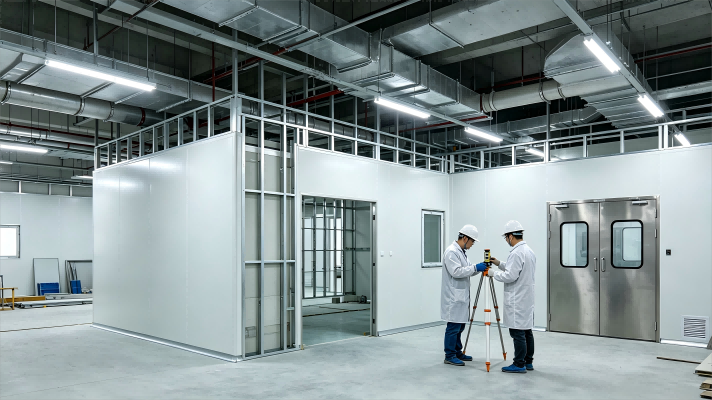
In cleanrooms and controlled environments, the direction and velocity of airflow act as silent guardians against contamination. By carefully choreographing unidirectional flows and strategically positioning supply and exhaust vents, engineers can create invisible barriers that sweep particles away from sensitive areas. Even minor turbulence can trap contaminants, making it crucial to model airflow patterns during the design phase and validate them through smoke studies and real-time monitoring.
The interplay between pressure differentials and air exchange rates is equally critical. Maintaining a cascading pressure regime—highest in sterile zones, gradually decreasing toward less critical areas—prevents the ingress of unfiltered air. However, achieving this balance requires more than just adjusting fan speeds; it demands a deep understanding of how equipment, personnel movement, and door operations influence the entire room's aerodynamics. Fine-tuning these dynamics minimizes the risk of particle deposition on exposed products or equipment.
Modern computational fluid dynamics (CFD) tools allow us to simulate and optimize these invisible flows before construction even begins. By predicting how air will behave around heat-generating machinery or in the presence of moving personnel, facilities can eliminate dead zones and recirculation loops that often harbor contaminants. This proactive approach transforms airflow from a passive design element into a dynamic, controlled shield against contamination risks, ensuring product integrity and patient safety.
Industry-Ready Solutions from Pharmaceuticals to Microelectronics
From lyophilization in pharmaceutical stability to precise thermal management in semiconductor manufacturing, our solutions are designed for the exacting demands of production environments. Each system integrates seamlessly into existing workflows, backed by decades of application expertise across highly regulated industries.
We bridge the gap between lab-scale innovation and full-scale industrial deployment. Through modular engineering and custom automation, we help manufacturers achieve repeatable results at throughput levels that make sense for their operations—whether they’re drying heat-sensitive vaccines or controlling humidity in photolithography areas.
Reliability isn’t added at the end; it’s built into every component. Our platforms undergo rigorous qualification protocols, ensuring consistent performance under 24/7 duty cycles. The result is a portfolio that tackles the real-world variability of industrial processing without compromising on precision or compliance requirements.
Advanced Materials Engineered for Sterile Durability
The selection of polymers in cleanroom environments goes beyond simple chemical resistance—it demands a deep understanding of how materials behave under repeated sterilization cycles. Advanced formulations are now engineered at the molecular level to resist chain scission and cross-linking that typically lead to embrittlement or discoloration. By carefully balancing additives and base resin crystallinity, these materials maintain their structural integrity and surface finish even after hundreds of autoclave or gamma irradiation exposures, ensuring consistent performance in critical applications.
Surface properties play an equally vital role in sterile settings. Microscopic roughness or residual surface charges can trap contaminants or promote biofilm formation, undermining sterility. Our materials address this through precision-controlled surface treatments that minimize adhesion without relying on temporary coatings. The result is a durable, non-porous barrier that repels particulates and resists chemical attack from aggressive cleaning agents, all while meeting USP Class VI and ISO 10993 biocompatibility standards.
The practical impact of these material advancements is most evident in high-wear components like seals, valves, and tubing connectors. Unlike generic engineering plastics that can crack or fog after repeated exposure to vaporized hydrogen peroxide or ethylene oxide, our sterilizable elastomers and thermoplastics retain their flexibility and clarity. This not only extends service life but also reduces the risk of particulate generation—a factor that directly influences product quality in pharmaceutical manufacturing and medical device assembly.
Navigating Regulatory Standards with Proven Compliance
Regulatory landscapes shift constantly, and staying aligned can feel like chasing a moving target. Our approach cuts through the noise by embedding compliance into everyday operations, not treating it as a separate checklist. We’ve helped organizations turn rigid standards into practical, repeatable processes that reduce friction and keep teams focused on their core goals.
Trust is built when compliance is visible and verifiable. Instead of promising theoretical safeguards, we lean on a track record of audits, certifications, and real-world scenarios where our methods held up under scrutiny. The result is a framework that doesn’t just satisfy inspectors but actually strengthens your position — turning a regulatory hurdle into a measurable advantage.
Seamless Integration into Your Existing Facility Workflow
Bringing new equipment into a busy facility can feel like trying to replace an engine mid-flight—everyone’s worried about downtime, compatibility headaches, and retraining staff. That’s why our system was designed from the ground up to slip into your current operations without a hitch. It speaks the same language as your existing control systems, supports standard industry protocols, and doesn’t demand that you rip out perfectly good infrastructure just to accommodate a new box. The goal is to make your life easier, not create more work for your maintenance team.
We’ve seen too many installations where the “simple” new machine turns into a month-long integration project, complete with custom code and angry shift managers. So we built our platform to be genuinely plug-and-play—not the marketing version of that phrase, but the kind where you unbox it, make a few physical connections, and within an hour it’s sharing data with your SCADA or MES exactly as expected. It comes pre-loaded with profiles for the most common setups, and if yours is unique, the configuration is done through a straightforward interface that doesn’t require a PLC expert on standby.
Beyond the technical bits, we focused on how people actually work. The interface aligns with typical shift handover routines, alerting follows your escalation protocols instead of forcing new ones, and the safety interlocks integrate directly with your facility’s existing emergency stop circuits—no workarounds, no black boxes. It’s the kind of quiet, dependable upgrade that fades into the background, letting your team keep their rhythm while you unlock the benefits of modern automation.
FAQ
A GMP cleanroom is a specially engineered space where airborne particles, temperature, humidity, and pressure are tightly regulated to meet Good Manufacturing Practice standards. These rooms are critical in industries like pharmaceuticals and biotech because even microscopic contaminants can ruin product integrity or compromise patient safety.
A custom design is built around your specific processes, equipment, and workflow rather than forcing you to adapt to a fixed layout. This means optimized material flow, better zoning for different cleanliness levels, and integration of specialized utilities—all resulting in higher efficiency and fewer operational compromises.
Key considerations include the required ISO class, particle counts per cubic meter, air change rates, pressure cascade strategy, personnel and material entry protocols, and future scalability. You also need to account for the structural support needed for heavy HVAC systems and vibration-sensitive equipment.
Surfaces must be non-shedding, non-porous, and easy to sanitize. Common choices include stainless steel, smooth vinyl or epoxy flooring, and wall panels made of powder-coated metal or high-pressure laminates. All joints are sealed to prevent microbial growth and simplify cleaning.
It starts with a detailed design qualification, followed by procurement of compliant materials. Construction involves building the envelope, installing HVAC and filtration systems, finishing interiors with cleanroom-grade surfaces, and then rigorous testing—such as particle counts, airflow visualization, and filter integrity—before final certification.
Continuous monitoring of airborne particles and pressure differentials is essential, along with scheduled filter replacements and regular deep cleaning using validated agents. Environmental monitoring programs and periodic requalification audits help catch deviations early and maintain regulatory readiness.
Absolutely. With careful zoning, dedicated air handling, and robust changeover protocols, a well-designed cleanroom can safely handle different products. Some setups use modular partitions or mobile equipment that can be reconfigured without compromising the controlled environment.
Conclusion
Every controlled environment comes with its own set of demands, which is why we approach cleanroom design as a collaborative, from-the-ground-up process. Instead of forcing your operations into a standard footprint, we map out layouts that follow your workflows, positioning personnel, equipment, and material flows exactly where they minimize interference and maximize efficiency. Underpinning this spatial strategy is a detailed air-handling plan: supply and exhaust grilles are placed after modeling turbulence and dead zones in CFD simulations, so that airborne particles are swept away from critical areas before they can settle. The construction materials play an equally active role—we select monolithic wall panels, crevice-free coving, and chemical-resistant finishes that handle frequent washdowns without degrading, keeping walls and ceilings themselves from becoming contamination sources over time.
Beyond the physical build, we bridge the gap between cleanroom performance and real-world production demands. From aseptic pharmaceutical suites that meet Annex 1 requirements to vibration-stable microelectronics bays, we engineer each environment to the specific ISO class and tolerance your process depends on. Our documentation package is built to accelerate your regulatory review, with all materials, welds, and filter certifications traceable in a format that auditors recognize. Crucially, we stage the build to keep your existing operations running—phased installations, utility tie-ins during planned downtime, and temporary barriers mean your facility doesn’t grind to a halt. The outcome is a cleanroom that feels like a natural extension of your plant, delivering compliance without disrupting the rhythm of your daily production.
Contact Us
Contact Person: Amy Yang
Email: [email protected]
Tel/WhatsApp: 008619330882686
Website: https://www.genopharmatech.com/