

Pickup Truck Floor Mat Manufacturer: How to Choose Durable Mats for Your Work Truck
2026-08-21
Your work truck isn't just transportation—it's a rolling workshop, and its floor takes the brunt of every muddy boot, dropped tool, and spilled coffee. That's why choosing the right pickup truck floor mat manufacturer matters more than you might think. In this guide, we'll walk through what separates truly durable mats from the ones that crack and curl within months. And if you're ready to skip the guesswork, FANDEWEI builds heavy-duty floor mats designed to keep up with the hardest-working trucks on the road.
Mud and Gravel From Work Boots Will Destroy a Flimsy Mat in Weeks
A flimsy mat never stands a chance against work boots. The first few days it just looks dirty. But every step pushes grit into the surface, and the fibers start to fray along the main footpath.
Mud dries into a crust, bonding gravel to the mat. When you pivot or drag a heel, that crust acts like coarse sandpaper. Thin mats lack the pile height to hide the grit, so it tears the loops from the backing rather than settling below the surface.
Within two weeks you’ll see bald patches near the door, curled edges, and holes where people turn. That’s not slow wear. It’s what happens when heavy-duty footwear meets a barrier that was never built for real grit.
TPE, Rubber, and Vinyl Each Handle Job Site Chemicals Differently
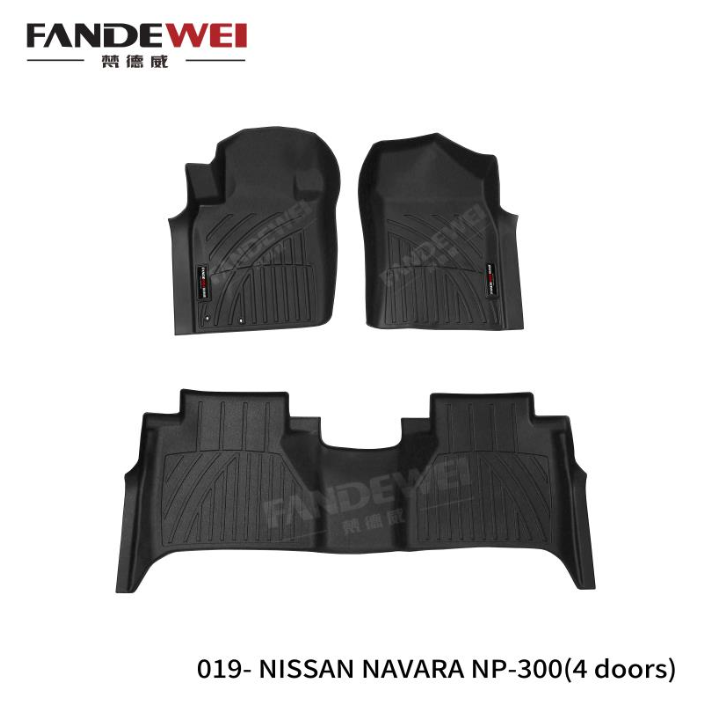
TPE, rubber, and vinyl each bring distinct properties to the job site when faced with harsh chemicals, solvents, and everyday spills. TPE typically offers broad resistance to many chemicals, especially oils and some acids, but its performance can vary depending on the specific formulation and the chemical involved. Rubber, particularly natural rubber, excels in resisting alcohols and many organic acids, yet it struggles with petroleum-based fluids, which can cause swelling and degradation. Vinyl, or PVC, is often chosen for its resilience against acids, alkalis, and many inorganic chemicals, though it may not hold up as well with ketones, esters, or chlorinated solvents. Understanding these differences is critical for selecting the right material for chemical-heavy environments, where missteps can lead to premature failure or safety risks.
On a practical level, job site exposure rarely involves a single chemical, so the interaction between material and mixture matters. For example, a TPE hose may handle mild cleaning agents and occasional oil contact without issue, but prolonged exposure to aggressive solvents could soften its surface. Rubber boots or seals might stand up to alcohol-based sanitizers yet degrade quickly if diesel or gasoline is present. Vinyl sheeting or conduit often survives acidic washdowns in food processing or industrial settings, but it can become brittle when in contact with plasticizers or certain organic compounds. Rather than relying on generic chemical resistance charts, it pays to test a small sample under actual conditions, as temperature, concentration, and duration of exposure can dramatically shift outcomes.
Cost and maintenance also enter the equation when deciding among these materials for chemical-prone tasks. Vinyl tends to be the most economical upfront, but its lower flexibility in cold weather and potential for cracking under repeated chemical attack may lead to more frequent replacements. Rubber offers excellent elasticity and tear strength, yet its sensitivity to UV and ozone—common on outdoor job sites—can shorten service life unless additives are used. TPE often bridges the gap with a balance of flexibility, chemical tolerance, and ease of processing, though higher-grade formulations come at a premium. The smart approach is to map out the specific chemical inventory on your job site, note temperature swings and mechanical demands, then pick the material that delivers the best long-term value rather than simply the lowest initial cost.
A Precise Fit Stops Pedal Jams and Rust Traps Under the Mat
A mat that doesn't follow the exact shape of your footwell will eventually shift, and that's when trouble starts. The edge creeps toward the accelerator or brake pedal, creating a lip that can catch your shoe mid-motion. With a precise cut, every curve and notch of the floor pan is accounted for, so the mat stays put without relying on clips alone. There's no excess material bunching under the pedals, and no need to kick it back into place at every red light.
Underneath a loose mat, water, road salt, and grit find an easy hiding spot. Over time that trapped moisture works into the carpet and the metal beneath, turning a small gap into a rust problem you won't notice until it's expensive. A snug fit leaves no open pockets for debris to collect. Instead of holding dampness against the floor, the mat sits flush, letting the surface dry instead of stewing in whatever the weather dragged in.
You shouldn't have to think about your floor mats while driving. When the shape is right, the mat disappears into the cabin—no sliding forward on hard stops, no raised corners at the door sill, no quiet crinkle every time you adjust your feet. That kind of fit doesn't just protect the carpet; it removes a distraction that can turn into a hazard in sudden braking or tight merges.
Deep Treads and Raised Edges Cut Cleanup Time Without Extra Effort
The deep tread pattern works like a series of small catch basins, grabbing mud, sand, and slush before they ever reach your floors. Raised edges act as a retaining wall, keeping all that captured mess from spilling over the sides when you step off or shake the mat out. Together they mean you are not chasing dirt across the room or reaching for a vacuum every time someone walks in from the garage.
Cleanup becomes a simple dump-and-go routine. Since the raised lip contains liquids and loose debris, you can carry the mat outside, tilt it once, and let gravity do the heavy lifting. No scrubbing, no spraying, no extra passes with a broom. The design does the containment work for you, so the time you used to spend on touch-ups now goes back into your day.
Attachment Hardware That Stays Put on Rough Roads and Steep Inclines
On washboard gravel and rutted fire roads, standard bolts and brackets work themselves loose within a few miles. The fix usually comes down to pairing a split-ring lock washer with a nyloc nut and a drop of medium-strength threadlocker on the final thread. That combination handles high-frequency vibration without making future removal a fight.
Steep inclines add a different kind of stress: shear load and constant pull. Here, through-bolting beats self-tapping screws every time. Use a backing plate or oversized washer on the inside of the mounting surface so the hardware can't tear through. For anything that needs occasional repositioning, a ratchet strap with a cam buckle holds tighter than a friction buckle, and the teeth bite into webbing even when the load shifts backward on a 20-degree slope.
Cheap Mats End Up Costing More Than One Durable Set by the End of the Year
A bargain mat feels fine for the first month. The foam compresses, edges curl, and the surface starts shedding bits onto the floor. You buy a second one to replace it, then a third when that one tears under a chair. By autumn the total quietly matches a mid-range option, and the cheap ones are already in the trash.
Durability is not just about thickness. A dense, well-bonded core keeps its shape under daily standing, desk wheels, and occasional spills. Cheap mats often use softer materials that break down fast, so the “saving” disappears with each replacement. You also lose time cleaning shredded pieces and dealing with trip hazards.
One solid mat may cost more upfront, but it stays flat, grips the floor, and protects carpet or hardwood for several years. If you compare actual spending over twelve months—not the sticker price—the supposedly expensive option is usually the cheaper one.
FAQ
Focus on the rubber compound itself. A high natural rubber content with reinforcing agents like carbon black resists tearing and chemical breakdown far better than cheap PVC or blended mats. Ask the manufacturer whether the mat is compression molded rather than extruded; compression molding creates a denser, more uniform surface that won't flake or crack when a tool box slides across it. For work trucks, stay away from foam-backed carpet hybrids—they soak up fuel and never come clean. A thick, solid rubber mat with a raised heel pad under the accelerator will outlast anything.
Custom-fit matters most around the edges and dead pedal area. Universal mats leave gaps where gravel, salt, and welding slag can slip underneath and grind into the truck's carpet or wiring. A laser-measured mat that snaps into the factory retention hooks won't bunch up under your brake pedal, which is a real safety issue when you're climbing in and out with muddy boots. You don't need a fancy logo, but you do need full perimeter lip coverage. That lip should be at least half an inch tall to trap slush before it runs toward the door sill.
Thickness alone isn't a guarantee, but for a work truck you want a mat that's at least 5/16 inch in the main footwell and ideally 1/2 inch under the heels. Look at the durometer rating if it's available—somewhere between 60 and 75 Shore A gives you enough flex to absorb impact without becoming a trampoline. If a mat feels light in your hand, it's probably full of air pockets that will crack. Pick it up; a front pair for a full-size pickup should weigh close to 10 pounds or more. Lightweight mats are usually extruded and won't survive a dropped tool.
Yes, partly. A dense rubber mat acts as a barrier, not an absorber, so it reduces high-frequency noise like tire whine and loose gravel pinging the floor pan. For heat, a full-coverage mat with a foil or jute backing can cut footwell temperatures noticeably on long hauls. Don't expect miracles—the biggest difference comes from closing air gaps. A mat that covers the transmission hump and fits tight against the firewall makes the cab feel quieter because it stops noise from bouncing around hard surfaces. If you want real acoustic deadening, add a mass-loaded layer under the mat, but the mat itself gets you halfway.
Use the factory retention hooks if your truck has them. If not, choose a mat with aggressive underside nibs or a molded spike pattern that bites into the carpet. Some aftermarket mats include screw-down anchors for hard floors, but be careful drilling into the floor pan—use a rubber grommet to prevent rust. For vinyl flooring, a heavy rubber mat with a high coefficient of friction will generally stay put on its own. Avoid any mat that relies on adhesive backing; heat from the transmission tunnel will melt the glue and leave a mess.
The $40 mat is usually extruded, thin (around 3/16 inch), and made with a high percentage of plastic filler. It will curl at the edges within a year and crack in freezing weather. The $120 work-grade mat is compression molded from a thicker sheet of virgin or high-recycled-content rubber, has reinforced heel pads, and includes a raised lip around the perimeter. It also tends to be heavier and more flexible at low temperatures. That price difference pays for itself the first time a gallon of hydraulic fluid spills and the cheap mat warps while the good one just hoses off.
Absolutely, but your needs change. On vinyl flooring, water and mud can't soak through, so the mat's job is more about traction and wear protection than containment. Look for a mat with a textured surface pattern that won't become slippery when wet. Some rubber compounds get slick with a little diesel on them, so test a sample if you can. Also, because vinyl floors don't have carpet to grab onto, a mat with a heavy, flat bottom works better than one with aggressive nibs designed for carpet. The nibs can actually create pressure points that wear through vinyl over time.
In a work truck, pull them at least once a month—more often if you're on dirt or gravel daily. Small stones and sand work their way under the edges and become sandpaper against the factory carpet or vinyl. When you remove the mat, lift it straight up rather than dragging it out, so trapped debris doesn't scratch the sill. Wash the floor with a mild degreaser, let it dry completely, then inspect for rust or worn spots near the dead pedal. Reinstall the mat only after the surface is fully dry; trapped moisture under rubber causes odor and corrosion faster than anything else.
Conclusion
When you're outfitting a work truck, the first thing to understand is that mud and gravel from boots will chew through a flimsy mat in a matter of weeks. That's why the material choice matters as much as the thickness. TPE, rubber, and vinyl each react differently to job site chemicals, so a mat that holds up to diesel and solvents on one site might break down on another. Look for a manufacturer that explains this trade-off instead of just listing specs. A precise fit is equally critical; a mat that slides or bunches can trap debris underneath and eventually interfere with the pedals. Deep treads and raised edges aren't just for looks—they keep slush and grit contained, so cleanup takes a quick hose-down rather than a scrub session.
On rough roads and steep inclines, attachment hardware is what keeps the mat from becoming a hazard under your feet. The best designs use anchors or clips that stay put through vibration and off-camber stops. It's easy to think a cheap set will do, but by the end of the year you've usually replaced them once or twice, and the total cost beats a single durable set. Choosing a manufacturer who focuses on real-world abuse—not just showroom appearance—means fewer returns, less floor corrosion, and a cab that still looks like a tool, not a trash can.
Contact Us
Contact Person: Jet
Email: [email protected]
Tel/WhatsApp: 8619903745266
Website: https://www.fandewei.com/