

Thoracic Aortic Stent Graft System Rankings and Reviews
2026-10-16
If you've ever tried to compare thoracic aortic stent graft systems side by side, you know the rankings don't always agree—and the reviews rarely tell you how a device behaves in a hostile arch. This guide cuts through that noise. Among the names worth watching, INT has carved out a reputation for controlled deployment and conformability, but how does it stack up against the established players? Read on for the comparisons that matter before your next case.
Which thoracic stent graft actually holds up in tortuous anatomy?
The question of durability in tortuous thoracic aortas tends to separate marketing claims from real-world performance rather quickly. Many stent grafts manage fine in straight or mildly curved segments, but once the anatomy introduces tight radii, kinking, or abrupt angulation, the differences become obvious. What matters is not just the device's nominal flexibility, but how it behaves under systolic pulse pressure while being forced to conform to a three-dimensional curve well beyond its resting shape.
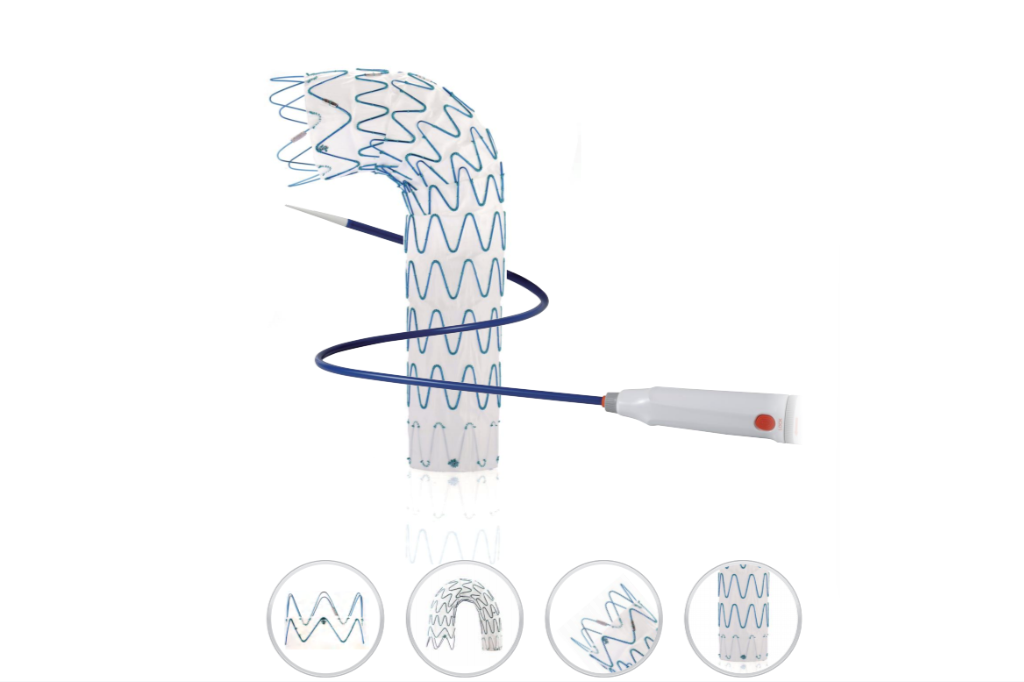
Among the commonly used options, grafts with a continuous helical nitinol skeleton often fare better than those relying on individual Z-stents connected by a thin fabric bridge. The helical design distributes bending stress more evenly, reducing focal kinks that can lead to infolding, type III endoleaks, or even component separation. Some devices also incorporate a proximal bare stent with an open-cell configuration that allows the endograft to flex without losing wall apposition in the inner curve of the arch. Clinical registries, though sparse for isolated tortuosity subgroups, hint that newer low-profile delivery systems do not always translate to better conformability once deployed — the chronic outward force and column strength matter just as much as the ability to track through a difficult iliac access.
In practice, the most reliable approach is to avoid oversizing aggressively in tortuous segments, because excessive radial force can straighten the native vessel and create a hinge point at the ends of the device. A stent graft that holds up is often one that respects the vessel's natural curvature rather than fighting it. Surgeons with extensive experience in complex arch and descending thoracic repairs tend to favor designs that demonstrate minimal bird-beaking on follow-up imaging, since that sign correlates strongly with late failure. Ultimately, the best thoracic stent graft for tortuous anatomy is the one with the lowest incidence of secondary intervention at three to five years — and that metric rarely appears in a brochure.
Why device sizing accuracy matters more than brand reputation
A well-known brand can give you confidence, but it won't resize your piping or rebalance your loads. Sizing accuracy dictates whether the equipment actually matches the conditions it will face every day. A slightly oversized chiller or an undersized heat exchanger from a top manufacturer will still cycle too often, waste energy, or fail to hold setpoints. The nameplate doesn't compensate for a wrong capacity calculation.
On the other hand, a lesser-known brand selected with precise sizing data often outperforms a famous one that was guessed into place. Contractors and facility managers learn this after a few uncomfortable summers or noisy winters. Reputation fades quickly when the equipment short-cycles, drips condensation, or never reaches the far ends of the building. Accuracy in sizing keeps the system in its efficient operating range, which matters more than any logo on the casing.
Real-world performance gaps the clinical trials won't show you
Clinical trials run in a world where every appointment is kept, every tablet is counted, and every adverse event has a code. Real life has none of that structure. A patient on three antihypertensives might skip the midday dose because their shift changed, or stop the new statin because the muscle ache feels worse than the cholesterol number. The trial never sees that version of the drug. It only sees the version taken on time, with regular monitoring, in a population screened to be just sick enough to show an effect but not so sick that the results get messy.
The gap gets wider with time and comorbidity. A biologic that looked clean in a 24-week study for rheumatoid arthritis may behave differently in someone with latent tuberculosis, a BMI over 40, and a history of shingles. The label won't tell you that the infection risk triples when the patient also needs a short course of prednisone for a flare. And the trial won't tell you what happens at month fourteen, when the initial response fades and the only real-world option is to add another immunosuppressant on top of a failing one. That kind of compounding complexity simply doesn't fit inside a protocol.
The useful evidence usually comes later, from registries, insurance claims, and clinic audits that capture what actually happens when a therapy moves from a binder of inclusion criteria to a waiting room full of exceptions. If you want to know how a treatment performs in ordinary hands, skip the glossy phase III charts and ask what the local pharmacist sees in her daily dispensing records. That is where the unvarnished performance numbers live.
A closer look at deployment mechanisms and physician learning curves
Deployment mechanisms in clinical settings rarely follow a single template. Some teams roll out a new device with intensive proctoring and simulation hours, while others rely on a brief vendor-led session and a few supervised cases. These choices shape the early learning curve more than the technology itself. A physician who trains on high-fidelity simulators and receives immediate feedback tends to plateau sooner, whereas one thrown into live cases without structured support may take far longer to reach stable performance.
Learning curves are often measured by operative time or complication rates, but those metrics miss subtle gains in decision-making and tissue handling. Two surgeons can have identical case counts yet differ dramatically in comfort with unexpected anatomy or intraoperative bleeding. The real learning curve involves knowing when to convert, when to ask for help, and when to slow down—skills that rarely appear in a logbook.
Progressive autonomy models work better than fixed case quotas. Early cases are heavily proctored, then supervision is gradually withdrawn as the physician demonstrates specific competencies rather than just logging hours. Regular case reviews and video-based feedback further compress the curve. Institutions that treat learning as an ongoing process, not a checkbox, see fewer early complications and more consistent adoption.
How newer low-profile designs are changing endovascular repair
The shift toward low-profile delivery systems in endovascular repair has quietly rewritten the rules for patient selection. Where once a 22 Fr or 24 Fr introducer was the norm, newer grafts now pass through 14 Fr or even 12 Fr sheaths, meaning many patients with calcified or narrow iliac arteries who would previously have been turned away can now be treated without an open conduit. That change has been especially meaningful in women and patients with peripheral arterial disease, two groups historically underrepresented in device trials but disproportionately affected by access-related complications.
Smaller introducers also blur the line between percutaneous and cutdown approaches. With lower-profile devices, a fully percutaneous EVAR is no longer a niche skill; it has become the default in many centers. The result is shorter procedure times, less groin morbidity, and earlier ambulation. At the same time, the reduction in profile has not come at the cost of durability. Engineers have reworked graft fabrics, stent skeletons, and deployment mechanisms to maintain seal and fixation while compressing everything into a markedly smaller capsule. Those iterative improvements, rather than any single breakthrough, are what make the current generation feel like a step change rather than a minor spec bump.
Perhaps most telling is how low-profile platforms are expanding the very definition of endovascular repair. Fenestrated and branched devices, once available only in large French sizes, are now being delivered through systems that can navigate tortuous anatomy without sacrificing precision. That means complex aortic repairs are moving from open surgery to endovascular territory in patients who would have been deemed unsuitable only a few years ago. As centers accumulate experience, the conversation is shifting from whether a patient can be accessed to what the ideal graft configuration should be—a sign that low-profile design is no longer just a convenience, but a genuine enabler of broader endovascular practice.
What patients and referring doctors should know before choosing a system
Patients usually care most about how easy it is to reach a real person when something goes wrong, and whether the system works on the devices they already use.
Referring doctors tend to look at a different layer: how referrals are tracked, how quickly reports come back, and whether the system creates extra steps for their staff.
A practical way to evaluate any option is to ask for a short trial with actual patient cases, not just a demo, and to check how the vendor handles data corrections and downtime.
FAQ
In day-to-day conversations, the names that come up most often are Medtronic’s Valiant Captivia, Gore’s TAG Conformable, Cook’s Zenith Alpha Thoracic, and Terumo’s Relay Pro. Each has a slightly different take on delivery profile, tip design, and how the graft material behaves in tortuous anatomy.
A lot of it comes down to how predictably the device deploys. If you can trust the proximal seal and don't have to fight the delivery system, that's half the battle. Reviewers also pay attention to trackability in tight arches, low-profile sheaths, and whether the instructions feel realistic for the anatomy they treat.
Yes, and that's a common point of confusion. Some systems are approved for aortic dissection repair and get specific praise for their conformability and radial force, while others are primarily used for degenerative aneurysms. A device might rank well for one indication but not the other.
Long-term data separates the devices that simply work in the short term from those that hold up over five or ten years. Reviews often cite migration rates, endoleak incidence, and secondary intervention rates. A low-profile system that saves procedure time might still get downgraded if its long-term seal isn't as durable.
One feature that gets a lot of attention is the tip capture mechanism on Medtronic devices, which allows for controlled deployment. Another is the staged deployment on Cook's Zenith Alpha, which helps with accurate placement. Gore’s TAG Conformable is often praised for its flexibility in tortuous aortic arches, and Terumo’s Relay Pro gets mentions for its dual-sheath design that reduces deployment force.
Both matter, but they answer different questions. Clinical evidence tells you about safety and effectiveness in controlled settings, while user feedback reflects how the device behaves in challenging anatomy and everyday operating conditions. Smart purchasers weigh both, but lean on user feedback when clinical data is sparse or outdated.
Quite a bit. Manufacturers iterate frequently, so a device that was mid-pack two years ago might move up after a sheath reduction or a new graft material update. Reviews that don't mention the specific version can be misleading because a Zenith or Valiant name covers multiple generations.
No, and any review that claims a single best system should be read with caution. The right choice depends on patient anatomy, the operator's familiarity, and the specific pathology. Rankings are more useful as a guide to the strengths and trade-offs of each platform than as a purchase decision in themselves.
Conclusion
When comparing thoracic aortic stent graft systems, the first question many operators ask is which device truly conforms in tortuous anatomy. Bench testing and registry data often diverge, and a graft that looks stable in a straight aneurysm can kink or lose apposition in a sharply angulated arch. Sizing accuracy consistently outweighs brand reputation; oversizing by a few millimeters may improve seal in some necks but can also increase radial force and the risk of retrograde dissection, while undersizing invites type I endoleak. Real-world performance gaps, including late migration, fabric wear, and unexpected endoleaks, frequently emerge only after years of follow-up, far beyond the window of most pivotal trials.
Deployment mechanisms vary from pin-and-pull to controlled-release systems, and each imposes a distinct learning curve. A device that deploys predictably with minimal jump can reduce maldeployment in tight arches, but physician familiarity often matters as much as the mechanism itself. Newer low-profile designs are shifting the landscape by enabling percutaneous access and negotiating calcified iliac vessels more easily, though smaller introducer sizes sometimes come with trade-offs in graft material or branch patency. For patients and referring doctors, the choice should not hinge on marketing claims or a single ranking list. Instead, it depends on matching the patient's specific arch geometry, landing zone length, and access vessel caliber to a system whose failure modes are well understood by the implanting team.
Contact Us
Contact Person: Jeffrey
Email: [email protected]
Tel/WhatsApp: 86-0633-2230056
Website: https://www.sd-intmedical.com